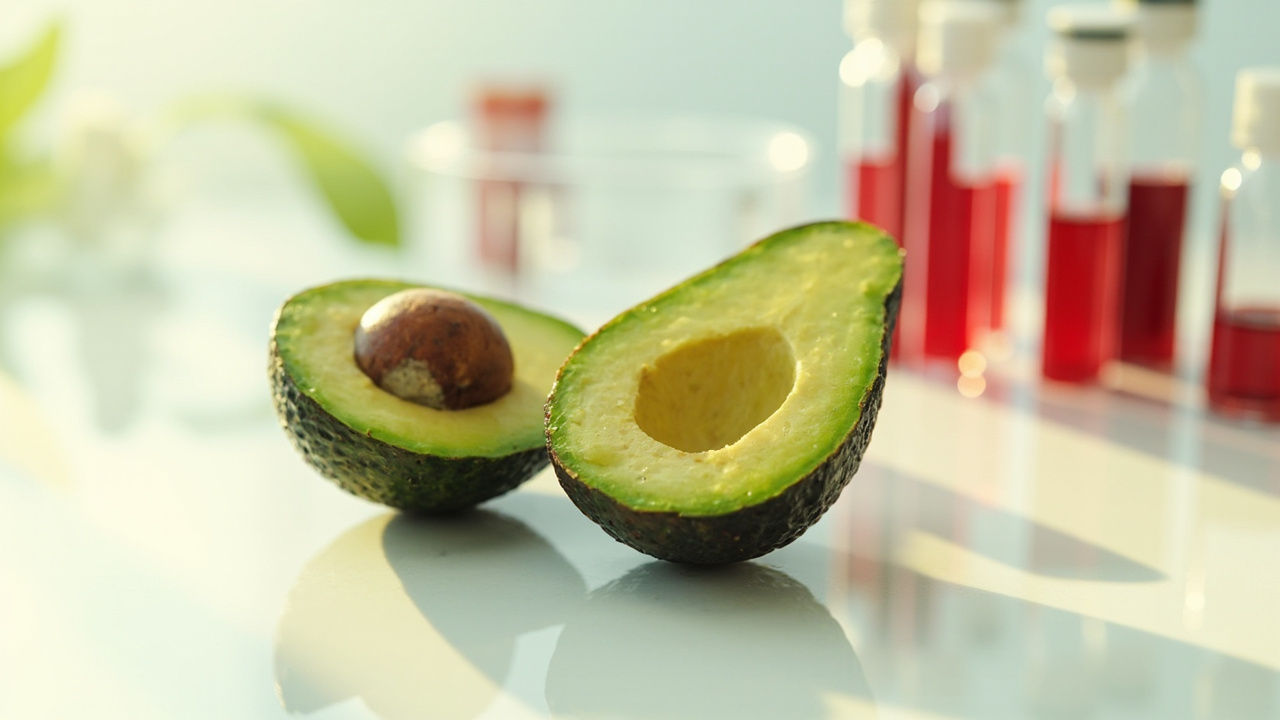
TL;DR: One avocado daily for 26 weeks lowered total LDL particle numbers in adults with abdominal obesity
TL;DR: In free-living adults with abdominal obesity, adding 1 avocado per day for 26 weeks reduced total LDL particle concentration by 49.1 nmol/L versus habitual diet without supplemental avocados, with no change in other particle groups.
According to JoVE Visualize, the finding comes from an ancillary study of the Habitual Diet and Avocado Trial, described as a multicenter, parallel-arm, 26-week randomized controlled trial. According to the Department of Medicine Blog, the full report appears as Damani JJ, Kris-Etherton PM, Matthan NR, Li Z, Sabaté J, Reboussin DM, Petersen KS in the Journal of Clinical Lipidology, published online June 12, 2026, ahead of print, PMID 42364969.
The background statement for the work was that avocado intake improves blood lipid profiles, but the effect on lipoprotein particles and subclasses is less clear. The stated objective was to investigate the effect of consuming 1 avocado per day for 26 weeks on change in lipoprotein particles and subclasses compared with a habitual diet without supplemental avocados in free-living adults with abdominal obesity.
Why particles were studied separately from standard lipids
Standard lipid panels report cholesterol carried in lipoproteins, while this ancillary analysis measured concentrations of lipoprotein particles and subclasses themselves. JoVE Visualize identifies those particle and subclass concentrations as exploratory outcomes in the ancillary study.
The distinction matters for interpretation because the parent-trial question concerned habitual eating with or without added avocado, not a controlled feeding formula. Participants lived freely and followed assigned eating instructions for half a year, rather than receiving every meal from a metabolic kitchen.
Researchers therefore framed the particle analysis as an extension of earlier lipid-profile observations. The aim was to determine whether daily avocado use altered the number and type of circulating particles in people selected for abdominal obesity.
How the Habitual Diet and Avocado Trial comparison was set up
The design summarized by JoVE Visualize was multicenter, parallel-arm, and randomized, with a duration of 26 weeks. One arm was designated the Avocado-supplemented Diet Group and the other was designated the Habitual Diet Group.
People assigned to the Avocado-supplemented Diet Group were provided with 1 avocado per day. People assigned to the Habitual Diet Group were instructed to follow their habitual diet. The comparison for the JoVE Visualize summary was habitual intake without supplemental avocados versus habitual intake plus the daily fruit.
The Pennsylvania State University affiliation listed for Damani, Kris-Etherton, and Petersen was the Department of Nutritional Sciences in University Park, PA. Additional co-authors listed in the citation include Matthan, Li, Sabaté, and Reboussin.
Who was included in the particle analysis
The analytical sample included 786 participants with available data. The Avocado-supplemented Diet Group included 389 participants, and the Habitual Diet Group included 397 participants.
The group as a whole was 74% female. Mean age was 51 years with a standard deviation of 14 years. Mean body mass index was 32.9 kg/m2 with a standard deviation of 5.4 kg/m2.
Eligibility for the underlying trial population was defined around abdominal obesity in free-living adults. The analysis included only participants with available fasting plasma data at the protocol-specified points.
How blood samples and measurements were handled
Fasting plasma samples were collected at baseline and at 26 weeks. Concentrations of lipoprotein particles and subclasses were then analyzed from those paired samples.
The laboratory method identified by JoVE Visualize was nuclear magnetic resonance spectroscopy. That method was applied to the exploratory particle and subclass outcomes, not to replace the parent trial's primary endpoints.
Between-group differences in the 26-week change from baseline were evaluated using linear regression. The regression models included adjustment for study site, consistent with the multicenter structure.
Main result: lower total LDL particle concentration
The Avocado-supplemented Diet Group had a reduction in total low-density lipoprotein particle concentration compared with the Habitual Diet Group. The reported mean difference was −49.1 nmol/L.
The 95% confidence interval extended from −83.6 to −14.5 nmol/L. The associated P value was 0.005.
In the conclusion reproduced by JoVE Visualize, the authors characterized the reduced particles as atherogenic LDL particles. The reduction referred to the 26-week change from baseline, compared between diet groups.
What did not differ between groups
No between-group differences were observed for LDL particle size. No between-group differences were observed for LDL subclasses either.
No between-group differences were observed for triglyceride-rich lipoprotein particles. No between-group differences were observed for high-density lipoprotein particles.
No between-group differences were observed for apolipoprotein A. No between-group differences were observed for apolipoprotein B.
The conclusion therefore distinguished one altered measure from several unaltered measures. Incorporating 1 avocado per day for 26 weeks reduced the concentration of atherogenic LDL particles without affecting other lipoprotein particles and subclasses in adults with abdominal obesity.
Reading the size of the LDL-particle difference
The point estimate of −49.1 nmol/L represents the between-group difference in change, not the final concentration in either arm. It was calculated from baseline-to-26-week changes in the two randomized groups.
The confidence interval from −83.6 to −14.5 nmol/L did not include zero. A P value of 0.005 was reported for that comparison.
Because particle and subclass endpoints were designated exploratory, the result is best understood as additional lipid-related information from the randomized comparison. The statistical approach adjusted for study site across the participating centers.
Publication record for this ancillary report
The Department of Medicine Blog lists the article as Effect of incorporating 1 avocado per day on lipoprotein particle concentrations compared to habitual intake in adults with abdominal obesity: An ancillary study of the Habitual Diet and Avocado Trial, a randomized controlled trial.
The journal record given there is J Clin Lipidol. 2026 Jun 12:S1933-2874(26)00397-1. The digital identifier is doi: 10.1016/j.jacl.2026.06.005, published electronically ahead of print.
The PubMed identifier is PMID 42364969. JoVE Visualize dates its summary page June 27, 2026, with an update noted June 28, 2026, while the Department of Medicine Blog entry is dated June 28, 2026.
What the study does and does not establish
What was tested was incorporation of 1 avocado per day into habitual diets for 26 weeks. What was compared was that supplemented pattern against habitual diet without supplemental avocados.
Who was studied was free-living adults with abdominal obesity, with the analytical sample averaging 51 years of age and a body mass index of 32.9 kg/m2. How long they were followed for this comparison was 26 weeks, with fasting samples at the start and end.
What changed was total LDL particle concentration. What did not change in the between-group comparison was LDL size and subclasses, triglyceride-rich lipoprotein particles, high-density lipoprotein particles, and apolipoproteins A and B.
How to use this result in everyday eating decisions
For readers, the practical element is the tested behavior: eating 1 avocado per day as part of an otherwise habitual diet. The trial supplied the daily fruit to the supplemented group rather than asking participants to infer a portion.
For context, the comparator was not avocado avoidance plus a different prescribed diet. It was continuation of habitual eating without supplemental avocados, with change assessed after 26 weeks.
Anyone considering a daily-avocado pattern should treat the particle finding as one randomized-trial signal in adults with abdominal obesity. The measured benefit concerned total LDL particle concentration, while other particle, subclass, size, and apolipoprotein measures showed no between-group difference in this analysis.
Sources referenced
- JoVE Visualize - Effect of incorporating 1 avocado per day on lipoprotein particle concentrations (https://visualize.jove.com/42364969-effect-of-incorporating-1-avocado-per-day-on-lipoprotein-particle-concentrations-compared-to-habitual-intake-in-adults-with-abdominal-obesity-an-ancillary-study-of-the-habitual-diet-and-avocado-trial-a-randomized-controlled-trial)
- Department of Medicine Blog - Effect of incorporating 1 avocado per day on lipoprotein particle concentrations (https://connect.uclahealth.org/dom/2026/06/28/effect-of-incorporating-1-avocado-per-day-on-lipoprotein-particle-concentrations-compared-to-habitual-intake-in-adults-with-abdominal-obesity-an-ancillary-study-of-the-habitual-diet-and-avocado-trial/)