TL;DR: U.S. fresh meat recalls lower demand for ground beef briefly, with shoppers pulling back most after large contamination events and then returning to normal buying patterns.
The newest verified federal action shows how that cycle works. On March 23, 2026, the U.S. Department of Agriculture's Food Safety and Inspection Service issued a public health alert for a ground beef item that may contain metal, according to the agency's announcement titled FSIS Issues Public Health Alert for Ground Beef Products Due to Possible Foreign Material Contamination. The product was made on Feb. 26, 2026, carries establishment number EST 34729 and a stamp reading 105761 Sell by 03/19/26, and went to a distributor and Mom's Organic Markets stores in the District of Columbia, Massachusetts, Maryland, New Jersey, Pennsylvania and Virginia. The company found the issue after two consumer complaints. No confirmed injuries were reported, and a recall was not requested because the item was no longer available for purchase.
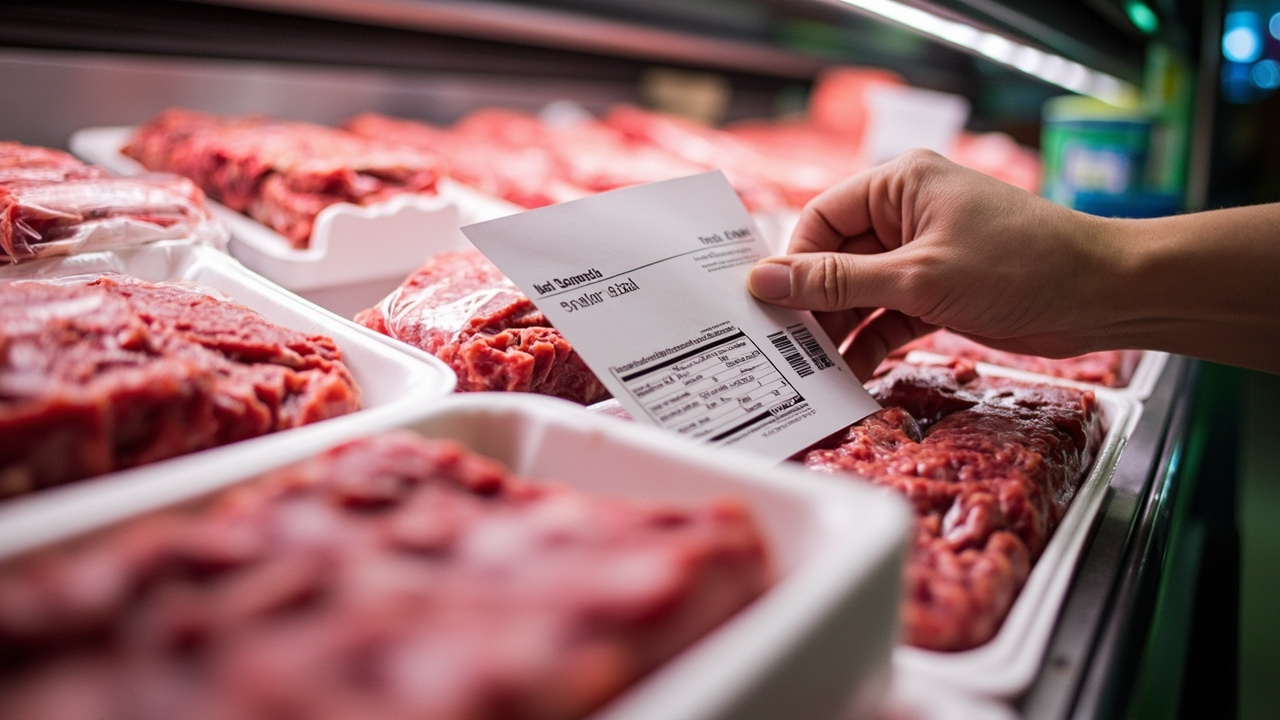
That alert is one of several recent ground-beef actions that illustrate the steady drumbeat facing the U.S. fresh meat case. Each event removes product, triggers warnings about freezers, and reminds shoppers that ground beef needs thorough cooking.
What the latest recalls removed from the market
Federal recall records show small and mid-size lots, quickly flagged through testing or complaints, with most attention on Shiga toxin-producing E. coli.
On Dec. 27, 2025, the Food Safety and Inspection Service announced that Mountain West Food Group, LLC of Heyburn, Idaho, was recalling approximately 2,855 pounds of raw ground beef that may contain E. coli O26, as described in Mountain West Food Group, LLC Recalls Ground Beef Products Due To Possible E. Coli O26 Contamination. The product was produced on Dec. 16, 2025, bore establishment number EST 2083, and was shipped to distributors in California, Colorado, Idaho, Montana, Pennsylvania and Washington for further retail distribution. The problem was found during routine agency testing. The agency later listed 2,424 pounds recovered. No confirmed illnesses were linked to the lot.
On Feb. 11, 2026, CS Beef Packers, LLC of Kuna, Idaho, recalled approximately 22,912 pounds of raw ground beef that may contain E. coli O145, according to CS Beef Packers, LLC Recalls Ground Beef Products That May be Contaminated With E. Coli O145. The items were produced on Jan. 14, 2026, carried EST. 630 inside the inspection mark, and were shipped to distributors in California, Idaho and Oregon for further distribution to foodservice locations. Discovery came from agency testing at a downstream customer. The agency listed 120 pounds recovered. No confirmed illnesses were reported, and foodservice operators were told not to serve the product.
An earlier alert shows national reach through retail. On June 3, 2025, the Food Safety and Inspection Service issued a public health alert for ground beef that may contain E. coli O157:H7, as reported in FSIS Issues Public Health Alert for Ground Beef Products Due to Possible E. Coli O157:H7 Contamination. The raw product was made on May 22, 2025 and May 23, 2025, bore EST. 4027, and was shipped to distributors in Connecticut, Georgia, Illinois and Maryland and then to Whole Foods Market stores nationwide. The company told the agency it had shipped product that tested positive. No confirmed illnesses were reported, and a recall was not requested because the items were no longer available for purchase.
A separate March 25, 2026 alert covered various raw beef and pork products made from April 2024 through March 2026 without federal inspection and that may bear a false inspection mark, according to FSIS Issues Public Health Alert for Beef and Pork Products Produced Without the Benefit of Inspection. The first four products used establishment number EST. 1996 without authorization and were shipped to wholesale and retail locations nationwide. The issue was found during an ongoing agency investigation. No confirmed illness or injury was reported.
How recalls affect fresh meat demand
Peer-reviewed studies using U.S. scanner and household purchase data find a consistent pattern: demand dips, then recovers.
A study in Food Policy in 2017 by Xia Shang and Glynn T. Tonsor, summarized as Food safety recall effects across meat products and regions, estimated effects of Food Safety Inspection Service recalls on U.S. consumer meat demand with monthly grocery-scanner data. It found that beef E. coli recalls significantly reduce demand for recalled ground beef at the time of the event in most, but not all, regions. The authors reported heterogeneity across products, regions and recall types, with domestic and international implications for policymakers and industry leaders.
A later analysis in the European Review of Agricultural Economics in 2023 by Hyejin Yim and Bhagyashree Katare, summarized as Effect of food safety recalls on consumer meat purchase: evidence from meat recalls 2007–2017, used household-level scanner data. It found that meat recalls have a statistically significant but short-lived and small reduction in consumer purchases, with small effects on both whether to buy and how much to buy. It also found differences by household demographics and recall characteristics.
An earlier demand study covering 1982–1998 built beef, pork and poultry recall indices from Food Safety Inspection Service events and newspaper reports and estimated a Rotterdam demand model. Published as Impacts of meat product recalls on consumer demand in the USA, it found that agency recall events significantly affected demand while newspaper reports did not, that recall elasticities were significant but small compared with price and income effects, and that gains for substitute meats were offset by a broader shift away from meat toward non-meat goods.
For shoppers, the takeaway is practical: sales and buying of the named ground-beef category can soften right after a well-publicized E. coli action, but the national market effect is usually limited in size and duration.
Why recall details matter more than headlines alone
Not all recalls move shoppers the same way. Research on information heterogeneity points to which features raise perceived risk.
A paper in Food Policy, Volume 114, January 2023, by Pei Zhou and Yizao Liu, summarized as Recall information heterogeneity and perceived health risk: The impact of food recall on fresh meat market in the U.S., modeled fresh-meat demand with a structural random coefficient discrete choice model. It examined the number of recalls and the volume recalled, plus interactions between historical and latest recall information. It reported that both the number of recalls and the volume recalled have negative and significant effects on demand, while historical recalls help mitigate the negative impact of the latest recalls.
The same study concluded that preventing large-scale recalls, Class I recalls, product contamination recalls, and recalls tied to production without benefit of inspection or import violation should be the highest priority. It also found that food companies should take the initiative to recall when problems arise, and simulation results implied that the number of recalls plays a much larger role than the volume recalled in meat demand.
That distinction helps explain market reactions in 2025–2026. A 22,912-pound Class I contamination recall to foodservice in three western states sends a different signal than a single-lot foreign-material alert for product already sold through, even though both trigger do-not-eat advice for freezers. Frequency of announcements can weigh more heavily than pounds in one lot.
The paper also noted broader context for why agencies act quickly. It cited Centers for Disease Control and Prevention estimates that about 48 million Americans get sick, 128,000 are hospitalized and 3,000 die from foodborne disease each year, and estimated the average cost of a recall to a food company at $10 million, with total losses equal to about 0.5% of total U.S. food sales in 2019.
Why ground beef draws frequent safety actions
Ground beef gets special scrutiny because grinding changes risk. According to the Food Safety and Inspection Service page titled Ground Beef and Food Safety, bacteria present on the surface of meat can be mixed throughout during grinding, and more surface is exposed. Harmful bacteria such as Salmonella, Shiga toxin-producing E. coli, Campylobacter jejuni, Listeria monocytogenes and Staphylococcus aureus cannot be seen or smelled.
The agency notes that bacteria multiply rapidly between 40 and 140 degrees F, a range it calls the Danger Zone. To keep levels low, it advises storing ground beef at 40 degrees F or below and using it within 2 days or freezing it. To destroy harmful bacteria, it advises cooking ground beef to a safe minimum internal temperature of 160 degrees F, confirmed with a food thermometer.
The agency separately explains that E. coli O157:H7 can survive refrigerator and freezer temperatures and can multiply very slowly at temperatures as low as 44 degrees F. Illnesses from E. coli O157:H7 have been linked with undercooked ground beef, as well as raw milk, apple cider, dry-cured sausage, fresh produce and undercooked roast beef. Color alone is not reliable, because patties can turn brown before reaching 160 degrees F, and some lean beef can stay pink above that point.
What shoppers and foodservice operators should do now
Federal advice after each of the recent actions is consistent: check freezers, do not eat the named product, and throw it away or return it.
For the March 2026 metal alert involving White Oak Pastures product sold at Mom's Organic Markets, consumers with the EST 34729 item stamped 105761 Sell by 03/19/26 were urged not to consume it. For the December 2025 and February 2026 E. coli recalls, consumers and foodservice locations were told the product may still be in home or commercial freezers despite effectiveness checks and recovery efforts.
General safe handling remains the market stabilizer. Separate raw meat from other foods, chill promptly, wash hands and surfaces often, and cook ground meats to 160 degrees F. Consumers with food safety questions can contact the USDA Meat and Poultry Hotline at 888-MPHotline, and problems with meat, poultry or egg products can be reported through the online Electronic Consumer Complaint Monitoring System.
For the fresh meat market, the pattern from both agency records and economic research is clear: targeted removal plus clear cooking guidance limits health risk, while repeated contamination headlines can briefly soften ground-beef demand until shoppers see the issue as resolved.