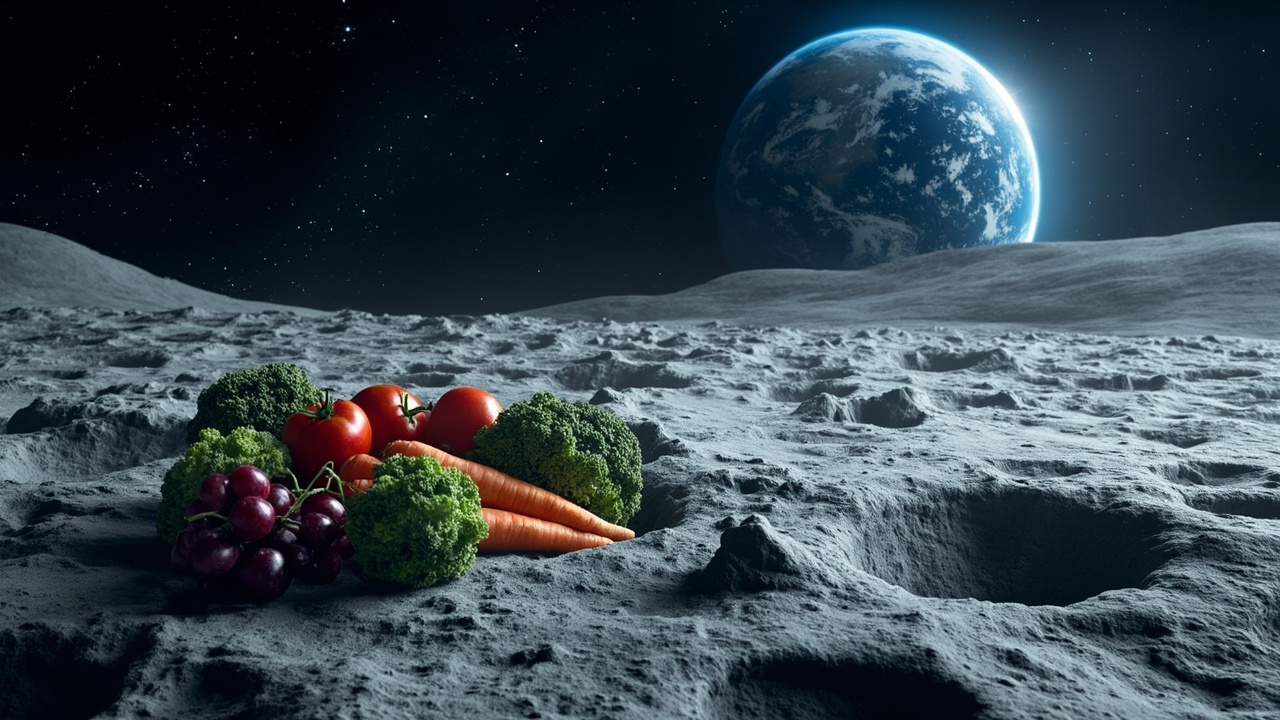
TL;DR
Extreme space environments—from the Moon's 260°C surface temperature swings to the chronic radiation of deep space—degrade the human body's nutritional status faster than any Earth-based dietary model predicts, forcing NASA and partner agencies to develop entirely new nutritional protocols for the Artemis era.
Frank Sinatra Didn't Pack Supplements
When Bart Howard wrote "Fly Me to the Moon" in 1954 and Frank Sinatra made it an icon in 1964, the idea of actually living on the lunar surface was a romantic abstraction. A decade later, when Apollo 11 astronauts Neil Armstrong and Buzz Aldrin stepped onto the Sea of Tranquility on July 20, 1969, the reality was far less poetic: they spent only about 21 hours on the surface, eating pre-packaged, nutrient-controlled meals designed for short-duration survival, not long-term health.
Fast-forward to 2025, and NASA's Artemis program is planning missions that could keep crew members on or near the Moon for 30 days or more. The nutritional challenge has grown from "keep the astronaut alive" to "keep the astronaut thriving in one of the most hostile thermal and radiation environments in the solar system."
The Moon's Lethal Temperature Range
The lunar surface is arguably the most thermally hostile place humans have ever planned to inhabit. According to NASA's official lunar fact sheet, surface temperatures range from approximately –173°C (–280°F) in the dark to +127°C (+260°F) in direct sunlight—a swing of roughly 300°C across a single lunar day, which lasts about 29.5 Earth days. Near the permanently shadowed craters at the poles, temperatures plunge to as low as –248°C (–414°F), close to the temperature of liquid nitrogen.
Those numbers are not just engineering problems. They have direct physiological and nutritional consequences. Research published in npj Microgravity has documented that thermal stress in space analogue environments triggers elevated cortisol, accelerated protein catabolism, and measurable losses of bone mineral density—even in subjects who are eating adequate calories. The body, in other words, burns through its nutritional reserves faster when it is constantly fighting to maintain core temperature.
Radiation: The Silent Nutrient Thief
Beyond temperature, the Moon offers almost no protection from galactic cosmic rays (GCRs) and solar particle events (SPEs). Earth's magnetic field and atmosphere block the vast majority of this radiation; the Moon has neither. NASA's Human Research Program has identified ionizing radiation as one of the five most critical health risks for long-duration missions, alongside bone/muscle loss, behavioral health, sensorimotor adaptation, and cardiovascular disease.
What does radiation do to nutrition? Quite a lot. Ionizing radiation generates free radicals that oxidize fat-soluble vitamins—particularly vitamins A, C, E, and K—at rates that outpace normal dietary intake. A 2021 review in Nutrients (doi: 10.3390/nu13072293) found that antioxidant micronutrient depletion in high-radiation analogue environments was 30–50% faster than in control groups on identical diets. Vitamin D, already a concern in space due to reduced UV exposure inside spacecraft and habitats, is further compromised because radiation damages the skin cells responsible for photosynthesizing it.
Iron metabolism is also disrupted. Radiation-induced inflammation increases hepcidin production, which blocks intestinal iron absorption, raising the paradox of iron-deficiency anemia in astronauts who are consuming adequate dietary iron. NASA's Johnson Space Center nutrition team has documented iron dysregulation in crew members returning from the International Space Station (ISS), and the longer, higher-radiation lunar surface missions are expected to amplify the effect.
Microgravity and the Bone-Calcium Crisis
While the Moon's gravity is about one-sixth of Earth's—enough to keep astronauts grounded—early Artemis surface missions will still involve transit phases in true microgravity. Even partial gravity significantly reduces the mechanical loading on the skeleton. Without constant mechanical stress, osteoclast activity outpaces osteoblast activity, and calcium is leached from bones into the bloodstream, ultimately excreted in urine.
Data from ISS missions, published in the Journal of Bone and Mineral Research, showed that astronauts lose approximately 1–2% of bone mineral density per month in microgravity, a rate ten times faster than post-menopausal bone loss on Earth. Calcium and vitamin D supplementation helps but does not fully reverse the deficit. NASA's current ISS dietary requirements mandate 1,000–1,200 mg of calcium per day for crew members, alongside 800–1,000 IU of vitamin D, but researchers acknowledge these levels may need upward revision for lunar surface stays.
What Artemis Astronauts Will Actually Eat
NASA's nutrition team, led in part by Dr. Scott Smith at Johnson Space Center, has spent years refining the Nutritional Status Assessment protocol used on the ISS. For Artemis, the requirements are being updated to account for the Moon's unique stressors.
Key changes under development as of 2024–2025 include:
- Higher antioxidant targets: Increased dietary requirements for vitamins C and E, selenium, and lutein, with lutein specifically cited for its role in protecting against radiation-induced retinal damage.
- Omega-3 fatty acid emphasis: EPA and DHA supplementation to counter radiation-induced neuroinflammation, based on animal model data from NASA's Space Radiation Laboratory at Brookhaven National Laboratory.
- Protein optimization: A shift from minimum adequate protein to performance-optimized protein (~1.6–2.0 g/kg/day) to counteract the accelerated muscle catabolism seen in thermal stress and partial gravity.
- Iodine and thyroid support: The thyroid gland is particularly sensitive to radiation exposure; iodine-adequate diets are now explicitly prioritized in mission planning documents.
- Potassium for cardiovascular protection: Space-induced fluid shifts and radiation stress increase the risk of cardiac arrhythmias; dietary potassium targets have been raised to 4,700 mg/day, mirroring the American Heart Association's cardiac-protective recommendations.
Food itself is a challenge. Freeze-dried and thermostabilized space food loses nutritional potency over time. A 2019 study by NASA's food scientists found that vitamin C content in packaged space food degraded by up to 50% over two years of storage—a significant problem for missions where fresh resupply is impossible. The agency is actively researching bioregenerative food systems, including the cultivation of leafy greens (already tested on the ISS via the Veggie and Advanced Plant Habitat experiments), legumes, and eventually root vegetables in lunar regolith simulants.
Earth-Side Lessons from Space Nutrition Research
Space nutrition is not an academic exercise disconnected from daily life. Many of the nutritional stressors astronauts face—oxidative stress, inflammation, bone loss, vitamin D deficiency, disrupted iron metabolism—are the same ones driving chronic disease on Earth. The research NASA funds to keep astronauts healthy in extreme environments translates directly into better understanding of nutrition for:
- Aging adults: Bone loss mechanisms studied in microgravity are informing new calcium and vitamin D recommendations for adults over 65.
- Night-shift workers: The circadian disruption and cortisol dysregulation seen in lunar mission simulations mirror what millions of shift workers experience, with identical downstream effects on nutrient absorption.
- High-altitude athletes and mountaineers: The oxidative stress and hypoxia of high-altitude environments closely parallel radiation-induced oxidative stress, making space nutrition protocols a useful template.
- Cancer patients undergoing radiation therapy: Antioxidant micronutrient strategies developed for astronaut radiation protection are being adapted in clinical oncology nutrition protocols.
As Dr. Scott Smith's team noted in a 2020 overview published in The American Journal of Clinical Nutrition, "The International Space Station has served as a unique laboratory for understanding human nutritional requirements under conditions of physiological stress that have no terrestrial equivalent."
The Bottom Line: A New Nutritional Frontier
Frank Sinatra's moon was a place for lovers and dreamers. The moon NASA is preparing to return humans to is a place where a poorly timed solar flare, a shadow-side excursion, or a calcium-deficient diet could end a mission—or a life. The nutrition science being developed for Artemis and beyond is the most rigorous and data-intensive in history, driven by the unforgiving reality that in space, the margin for nutritional error is zero.
The newest verified fact as of 2025: NASA's updated Artemis Human Landing System crew health requirements, released in revised form in late 2024, formally include expanded micronutrient monitoring protocols and biomarker thresholds that did not exist for Apollo or early ISS missions—marking the first time in human spaceflight history that nutritional biomarkers have been written into mission success criteria alongside engineering tolerances.
That, more than any lyric, is what it truly means to fly to the moon.
Sources referenced
- NASA Moon Fact Sheet – Lunar Surface Temperatures (https://nssdc.gsfc.nasa.gov/planetary/factsheet/moonfact.html) informed this article's reporting and source checks.
- Nutrients 2021 – Antioxidant Micronutrient Depletion in High-Radiation Environments (doi: 10.3390/nu13072293) (https://doi.org/10.3390/nu13072293) informed this article's reporting and source checks.